
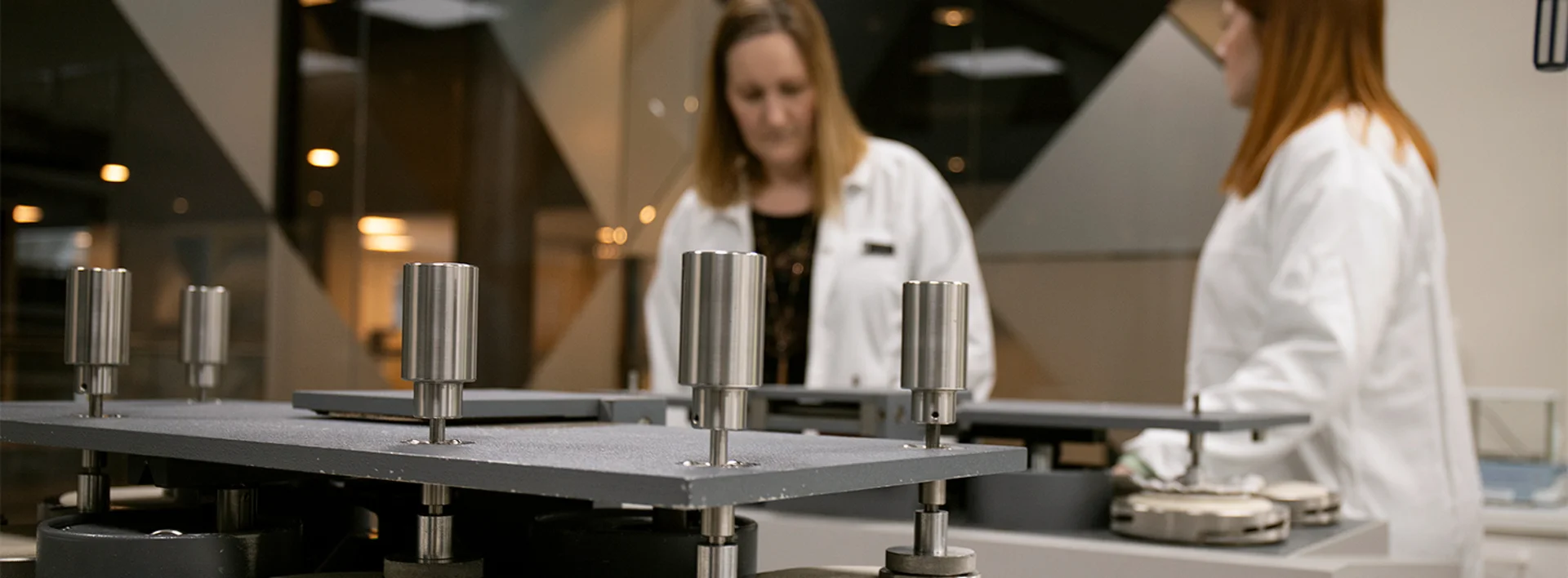

BYGGET STERKT. TESTET STERKERE.
Hos Fristads begynner kvaliteten lenge før et plagg når brukeren. I mer enn 30 år har vi drevet vårt eget laboratorium i Borås, Sverige, hvor vi tester de fysiske egenskapene til råvarer, tekstiler og ferdige plagg. Laboratoriet vårt spiller en nøkkelrolle i produktutviklingen, som et supplement til eksterne tester, og sikrer at tekstiler og funksjoner blir grundig evaluert før de lanseres. Vi evaluerer mekaniske egenskaper som slitestyrke, pilling, rivestyrke og strekkfasthet, samt fargebestandighet, dimensjonsstabilitet og vannavstøtning. Dette er et viktig skritt for å sikre at det ferdige produktet tåler både hard daglig slitasje og hyppig vask ved høye temperaturer.
De fleste testene utføres i et kontrollert miljø, i henhold til internasjonale standarder, for å garantere pålitelige og sammenlignbare resultater. Dette er avgjørende, siden tekstilfibre oppfører seg forskjellig i tørt og fuktig klima. Å ha et eget laboratorium gjør det også mulig for oss å utforme tilpassede tester som simulerer de virkelige forholdene plaggene våre utsettes for. Ved å kombinere våre egne tester med resultater fra eksterne laboratorier, industrielle vasketester og brukerforsøk, får vi en dypere forståelse av materialets ytelse og sikrer holdbarheten til vårt arbeidsklær. Dette engasjementet sikrer at hvert Fristads-plagg leverer på sitt løfte om langvarig funksjon, komfort og kvalitet.
Fristads er medlem av en arbeidsgruppe for tekstiler hos SIS, det svenske forumet for utvikling og oppdatering av gjeldende internasjonale standarder.

Tensile strength
A fabric sample measuring five cm in width is attached to a tensile tester and then subjected to increasing loads until it breaks. The maximum force registered during the test is recorded and shown in Newtons.

Tear strength
A sample piece of fabric is cut into the shape of a two-dimensional pair of trousers. The sample’s “legs” are secured in different directions in a tensile tester and then subjected to a load until one thread after another is torn off. The force per thread is measured and the mean value is then recorded in Newtons.

Abrasion resistance
The abrasion resistance of fabric is tested in a Martindale machine. Fabric samples are subject to abrasion against a standardised wool weave. At specified intervals, the fabric samples are examined under a microscope until two threads from each sample have severed. The result gives the number of rubs of abrasion the fabric can withstand.

Pilling resistance, Martindale method
Fabric samples are rubbed against a standardised wool weave in a Martindale machine. The pilling that arises on the sample is assessed against a scale from 1 to 5.

Resistance to surface wetting, spray test
The fabric sample is placed at a 45-degree angle in a spray rating tester. A specified quantity of water is then sprayed onto the fabric at a constant rate of flow. Wetting of the sample is assessed against a scale from 1 to 5.

Colourfastness
to laundering
Using a Gyrowash, fabric samples are washed together with a multifibre strip and steel balls placed in a separate container. A multifibre strip consists of different types of fibre. After washing, the degree of staining visible on the various types of fibre is assessed against a scale from 1 to 5. The colour change in the washed fabric sample is also assessed.