
IEC 61482-2
Electric arc
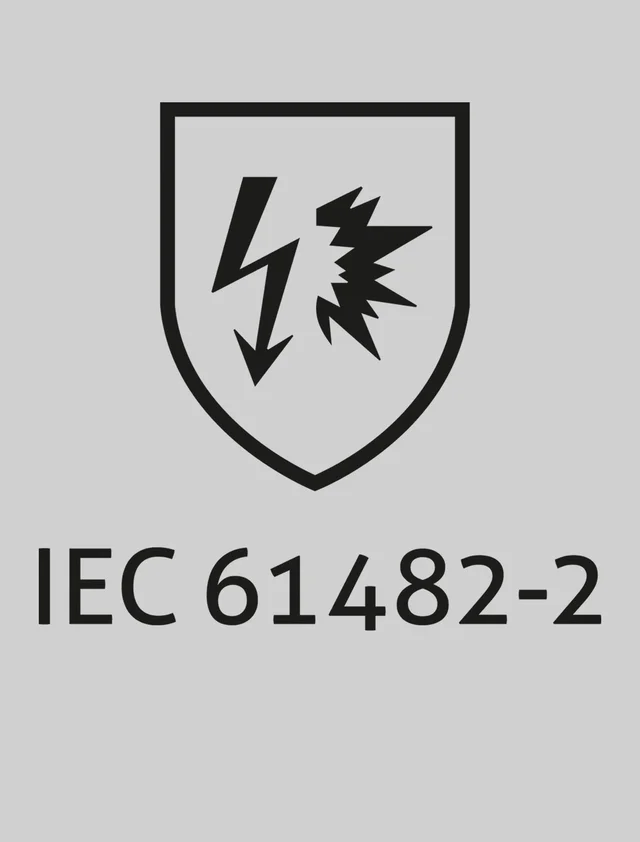
Protective clothing certified according to IEC 61482-2 should be used in environments where there is a risk of electric arc accidents.
During an electric arc explosion, the material is exposed to clouds of plasma, flames, radiation and metal that splashes from the electrodes. In that case, the material must insulate effectively enough to prevent second degree burns to the skin. An effective material for electric arc protective garments must protect both against the flame and the metal splash, while also insulating against intense heat. The standard IEC 61482-2 includes two test methods: EN 61482-1-1 (Open Arc) and EN 61482-1-2 (Box Test). Our garments are certified according to both methods.
Two-piece protective clothing must be worn together and protect the entire body to achieve the right level of protection. The CE labels inside the garment contains information about the necessary garment combination and which code letters that the garment is certified for. The protective clothing is usually worn together with other types of PPE such as helmet, gloves and shoes. Wearing additional layers of garments is very important and will increase protection.
For whom?
Electricians, when maintaining equipment in non-arc-safe distribution plants or electrical switchboards, or when working on high voltage equipment.
Protects against:
Electric arc, metal splashes, heat and flame, radiant heat convective heat, high voltage, electric shock, plasma clouds, radiation.
Open Arc Test – IEC/EN 61482-1-1
The test uses an arc that simulates reality by not being "controlled." You shoot the arc against a mannequin wearing one or more layers of garments and then evaluate the protection of the garments. The test measures the energy level, i.e. calorific value in cal/cm2, that the garment or garment combination can withstand. The value may be stated using three different test values. ELIM is the new way of indicating the protective energy level of the garment and complements ATPV and EBT.
The ELIM value indicates the energy level to which the garment may be exposed with a 0% risk of second-degree burn. ATPV and EBT are measured against a 50% risk of a second-degree burn. The ELIM value therefore has a lower calorific value than ATPV and EBT.
Whether it becomes an ATPV value or an EBT value depends on how the fabric reacts to the arc test. If a hole appears first, the value is set as EBT and if high heat passage is first, it will be ATPV. The result of the electric arc tests – the ATPV, EBT and ELIM values – are compared with the Stoll curve, a diagram that shows when you are at risk of a second-degree burn in the event of an electric arc accident. That way you can measure the energy level (calorific value) that the garments protect against.
ELIM (Incident Energy Limit) Indicates the energy level that the garment protects against, while maintaining a 0% risk of sustaining second-degree burns
ATPV (Arc Thermal Performance Value) Indicates the energy level that the garment protects against, while maintaining a 50% risk of a heat transfer that may cause second-degree burns.
EBT (Energy Breakopen Threshold) Indicates the energy level that the garment protects against, while maintaining a 50% risk of sustaining a hole in the material that may cause second-degree burns.
Box Test – IEC/EN 61482-1-2
The arc rating – APC 1 or 2 – is evaluated in a test with a limited and directional arc. APC is short for Arc Protection Class.
In the test, the electric arc is shot against a box where the material or garment is placed. The result is compared to the Stoll curve, a diagram that shows when you are at risk of a second-degree burn in the event of an electric arc accident.
Test criteria: The material must not melt on the inside, the afterflame must be extinguished in 5 seconds or less and no hole larger than 5 mm in any direction can be created. The result is approved or not approved.
APC 1 = 4 kA (arc energy 168 kJ)
APC 2 = 7 kA (arc energy 320 kJ)