

Built strong. tested stronger.
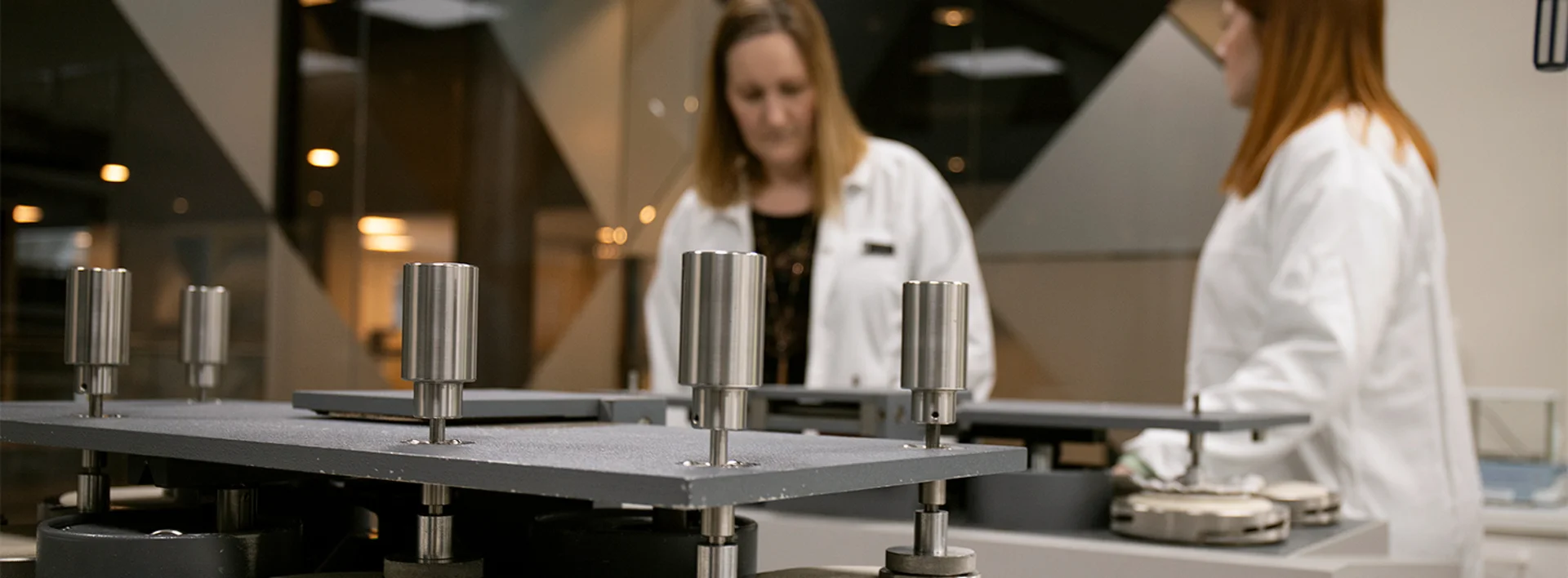
At Fristads, quality begins long before a garment reaches the user. For more than 30 years, we have operated our own laboratory in Borås, Sweden, where we test the physical properties of raw materials, fabrics, and finished garments. Our lab plays a key role in product development, complementing external tests and ensuring that fabrics and functions are rigorously evaluated before being introduced. We evaluate mechanical properties such as abrasion resistance, pilling, tear strength and tensile strength, as well as colour fastness, dimensional stability and water repellency. This is an important step to ensure that the finished product can handle both heavy everyday wear and tear and frequent washing at high temperatures.
Most tests are carried out in a controlled environment, following international standards, to guarantee reliable and comparable results. This is key, since textile fibres behave differently in a dry versus a humid climate. Having an in-house lab also allows us to design customised tests that simulate the real conditions our garments face. By combining our own testing with external lab results, industrial laundry tests and user trials, we gain a deeper understanding of material performance and safeguard the durability of our workwear. This commitment ensures that every Fristads garment delivers on its promise of long-lasting function, comfort, and quality.
Fristads is a member of a working group on textiles at SIS, the Swedish forum for development and updating of the international standards in use.

Tensile strength
A fabric sample measuring five centimeters in width is attached to a tensile tester and then subjected to increasing loads until it breaks. The maximum force registered during the test is recorded and shown in Newtons.

Tear strength
A sample piece of fabric is cut into the shape of a two-dimensional pair of trousers. The sample’s “legs” are secured in different directions in a tensile tester and then subjected to a load until one thread after another is torn off. The force per thread is measured and the mean value is then recorded in Newtons.

Abrasion resistance
Fabric samples are rubbed against themselves or against a standardised wool weave in a Martindale machine. At specified intervals, the fabric samples are examined under a microscope until two threads from each sample have severed. The result gives the number of rubs of abrasion the fabric can withstand.

Pilling resistance, Martindale method
Fabric samples are rubbed against themselves or a standardised wool weave in a Martindale machine. The pilling that arises on the sample is assessed against a scale from 1 to 5.

RESISTANCE TO SURFACE WETTING, SPRAY TEST
The fabric sample is placed at a 45-degree angle in a spray rating tester. A specified quantity of water is then sprayed onto the fabric at a constant rate of flow. Wetting of the sample is assessed against a scale from 1 to 5.

COLOUR FASTNESS TO LAUNDERINg
Using a Gyrowash, fabric samples are washed together with a multifibre strip and steel balls placed in a separate container. A multifibre strip consists of different types of fibre. After washing, the degree of staining visible on the various types of fibre is assessed against a scale from 1 to 5. The colour change in the washed fabric sample is also assessed.
More content for you:

materials
We carefully choose the materials and fabrics for our workwear based on the performance, durability and environmental impact of the finished garment.
Read more >

FOR PROGRESS
Download our company certificates, including ISO 9001, ISO 14001 and OEKO-TEX®, showing our commitment to quality, safety and sustainability.
Read more >

IS A TEAM EFFORT
Fristads’ quality controllers are our eyes and ears on the ground in Asia, working with our suppliers to ensure our products are made in sustainable ways.
Read more >